OmniNexus Team
Ad Copy Formulas: AIDA, PAS, BAB and FAB With Examples
Four ad copy formulas explained with a worked example each, when to use them, the mistakes that waste ad spend, and how to test one against plain copy.
You have a photo, an offer and a small budget, and a blank caption box. Most ad copy goes wrong at this point. The ideas are usually fine. They arrive in the wrong order. A copy formula is just an order: what the reader should see first, second and third.
Four formulas cover most small business ads: AIDA, PAS, BAB and FAB. Below, each one gets a plain explanation, the situation where it fits, and a worked example for an invented business. All the businesses here are examples, not real brands.
AIDA: Attention, Interest, Desire, Action
AIDA walks a stranger from "what is this" to "I'll tap it". You open with something that stops the scroll, add a detail that makes them curious, make them want the result, then tell them exactly what to do.
Fits when: the audience is cold. They have never heard of you, so you have to earn each step. It also suits a new product with no reputation yet.
Say you run a bakery in Bangsar and you are advertising a new pandan kaya loaf to people who have never bought from you.
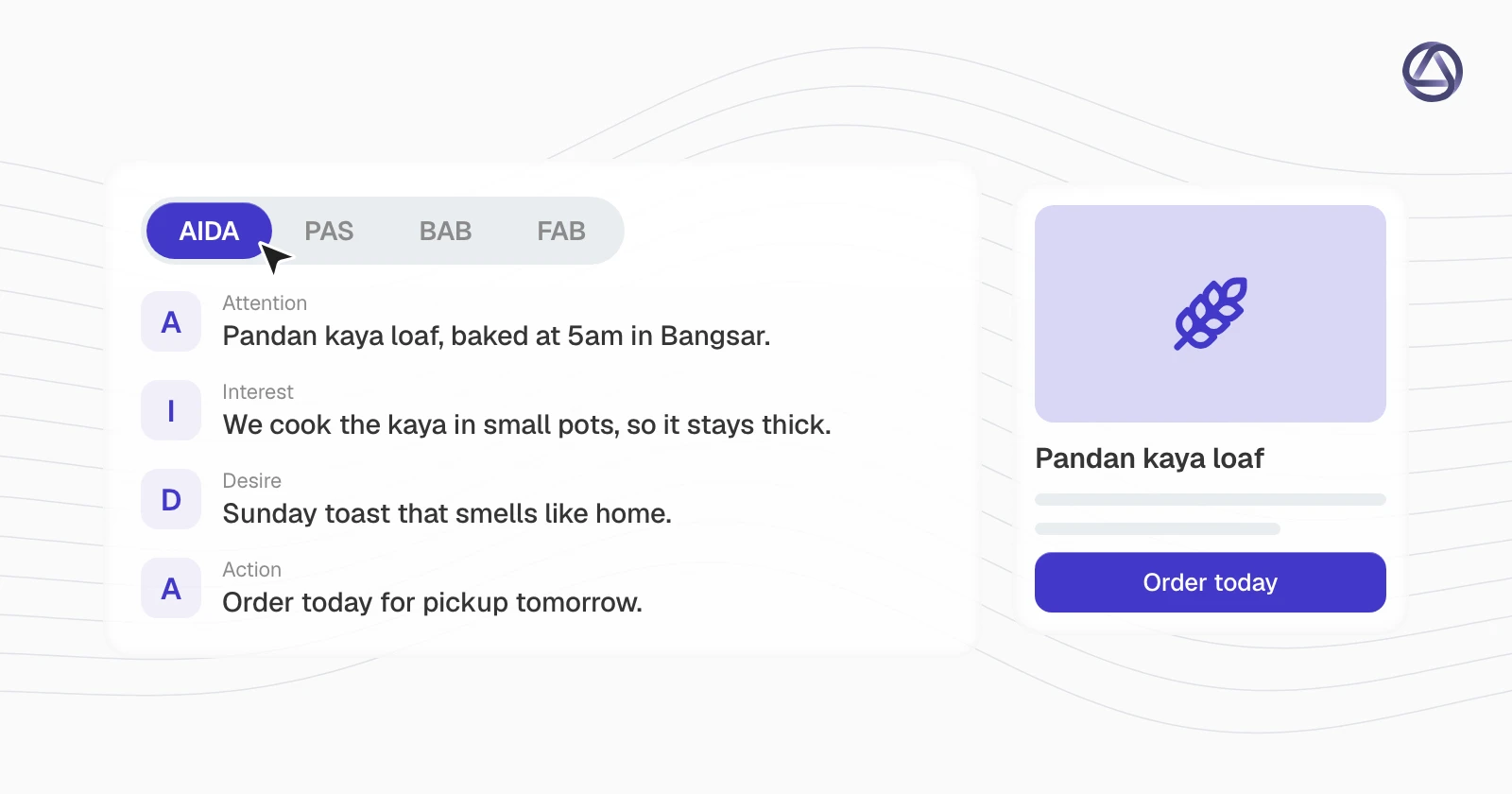
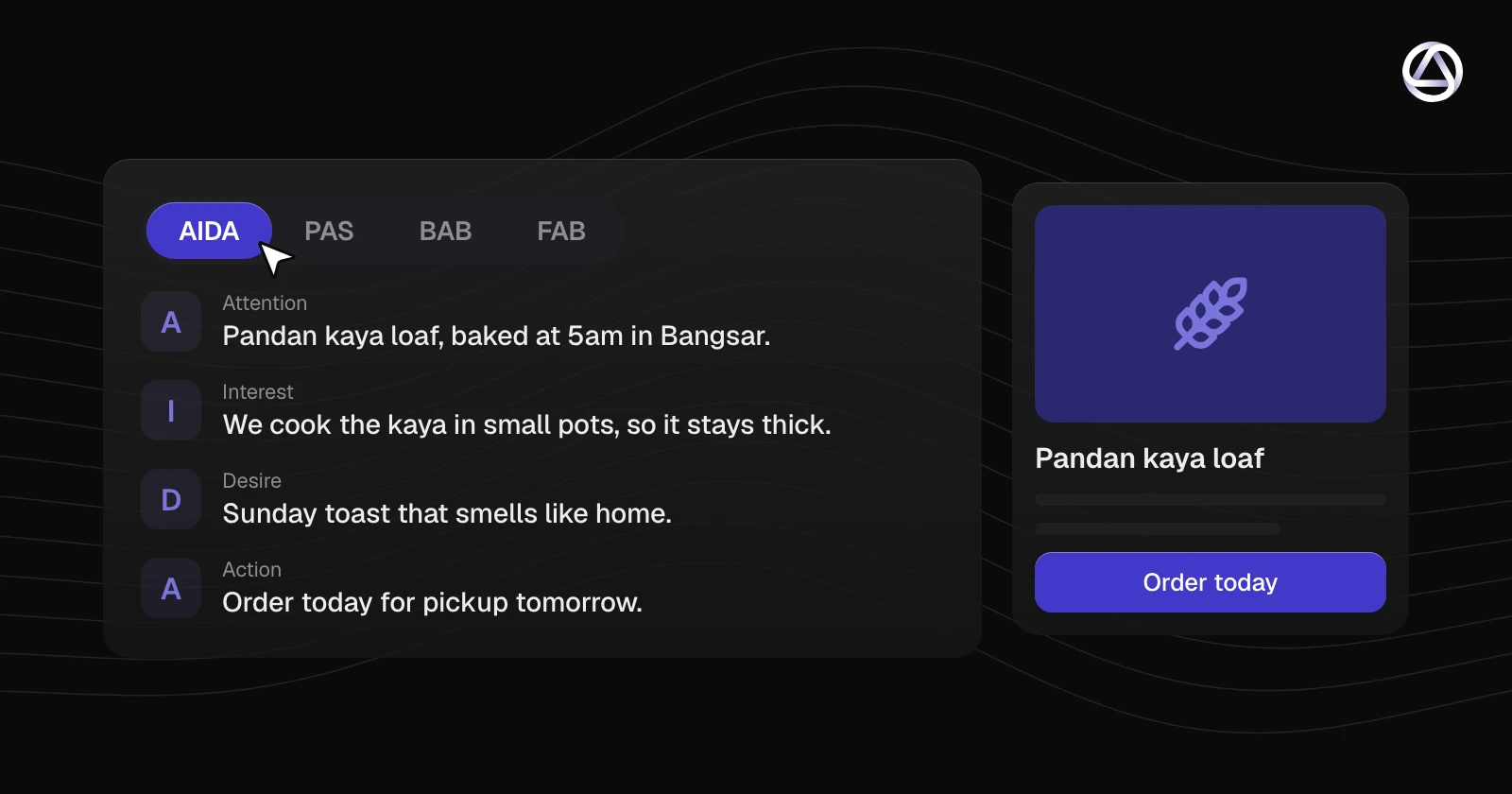
- Attention: "Pandan kaya loaf, baked at 5am in Bangsar."
- Interest: "We cook the kaya in small pots, so it stays thick and doesn't turn sweet and flat."
- Desire: "Toast a slice on Sunday morning and the whole kitchen smells like your grandmother's place."
- Action: "Order today for pickup tomorrow. Tap the button below."
Each line does one job. If you cut the interest line, the ad jumps from a pretty headline to a sales push, and cold readers don't follow.
PAS: Problem, Agitate, Solution
PAS names a problem the reader already has, makes them feel it a little, then offers your fix.
Fits when: the buyer is problem-aware. They know something is wrong and are looking for relief. They may not know you, but they recognise their own situation in your first line.
Say you run a tuition centre in Petaling Jaya for Form 3 students.
- Problem: "Your child understands maths in class, then freezes in the exam."
- Agitate: "You sit with them at 10pm, the same questions come back wrong, and neither of you is enjoying it."
- Solution: "Our small exam-skills group drills past-year question types every week until the freeze goes. Book a free assessment slot."
The agitate step is where most people overdo it. Two sentences of recognition is plenty. More than that and you are poking a sore spot rather than helping.
BAB: Before, After, Bridge
BAB paints life before your product, life after, and then bridges the two with what you sell.
Fits when: the result is visible and emotional, like fitness, skincare, home tidying or a clinic treatment. It also works well with image or video, where the before and after can be shown rather than described.
Say you run a gym in Jumeirah Village Circle (JVC) that offers evening beginner classes.
- Before: "You bought the membership in January and you've been twice."
- After: "Picture walking in on Thursday and knowing exactly what to do, with a coach and six other beginners at your level."
- Bridge: "That's our Thursday 7pm beginner class. Small group, no mirrors-and-grunting. Come to one session and see."
Keep the after believable. "Knowing what to do on Thursday" is something you can deliver. A promise of a new body in a short time is not, and readers who have seen a lot of gym ads will not believe it.
FAB: Feature, Advantage, Benefit
FAB starts with a fact about the product, explains why that fact beats the alternative, then says what it means for the buyer.
Fits when: the offer is feature-heavy and the reader compares options. B2B services and software are the usual case, because the buyer is checking a list.
Say you run a firm that handles payroll and statutory filings for small companies in Selangor.
- Feature: "We handle your EPF, SOCSO and EIS contributions each month."
- Advantage: "Nobody on your team needs to learn the portals or track the deadlines."
- Benefit: "Your finance person spends the last week of the month on cash flow, not on forms."
The benefit line is the one most ads skip. A feature with no benefit makes the reader do the translation, and most won't.
When each one fits
This table matches the situation to the formula.
| Situation | Formula | Why |
|---|---|---|
| Cold audience, new brand | AIDA | It builds attention from nothing |
| People who already know you | BAB or a short FAB | They need a reason to act now, not the attention step |
| Problem-aware buyers | PAS | Start where their frustration already is |
| A launch | AIDA for strangers, FAB for existing customers | Existing customers want to know what changed |
| A feature-heavy B2B offer | FAB | One benefit per feature |
You can mix formulas across a campaign. A launch might run an AIDA ad to a cold audience and a FAB ad to your past customers. Each ad should still follow a single formula so you can tell what you tested.
Common mistakes
Agitating too hard. In PAS, the reader should nod, not wince. If your problem line sounds like a threat, trust drops. Name the problem once, be specific, and move on to the fix.
Fake urgency. "Only 3 left" when you have fifty, or a countdown that resets, teaches your audience to ignore you. If the deadline is real, say it plainly: "Booking closes on 30 November because we only have 20 seats." If there is no deadline, leave the urgency out and let a clear next step do the work.
Features with no benefit. "Made with cold-pressed oils" means little until you add what it does for the customer's skin or day. After every feature, ask "so what?" and write that answer next.
Mixing formulas in one ad. An ad that starts as PAS and ends as BAB reads as confused. Pick one.
Pick one formula and test it against a plain version
You don't need a big budget to learn which style works for your business. You need two ads that differ in one way.
- Choose the formula that matches your audience from the list above.
- Write the formula version.
- Write a plain version: the same offer in two or three direct sentences, with no formula structure.
- Keep the photo, the offer and the call to action identical.
- Run both for the same period to the same kind of audience, with the same small budget. A round example would be RM100 or AED 100 each, but use whatever you can spare.
- Compare cost per result and conversion rate rather than likes. Check the comments too, because they show what people actually understood.
If the formula version wins, keep the structure and test a new headline next. If the plain version wins, that is useful: your audience may prefer directness, and you have learned it for a small cost. Change one thing at a time, otherwise you won't know what caused the difference.
Write down which ad won and why you think so. After a few rounds you will have a short note on what your customers respond to, which is worth more than any template.
Where Marvis fits
When you draft ads in Marvis AI, you can pick a tone and a copy formula such as AIDA or PAS, and write in any language. That makes it quick to produce the formula version and a plain version of the same offer, edit them, and approve the one you want to publish. If you want to try it, you can sign up here.
Before you open any tool, pick one live ad this week, match it to a formula from the list above, and write a plain version beside it.