OmniNexus Team
How to Spot Ad Creative Fatigue Before Results Slide
Ad creative fatigue shows up in frequency, CTR, cost per result and comments. Learn the signs, why small audiences hit it sooner, and how to refresh in time.
Your ad did well for the first couple of weeks. Then cost per result crept up, the comments went quiet, and you started wondering if the offer had gone stale. Often the offer is fine. People have simply seen the ad too many times.
That is ad creative fatigue. This post covers how to recognise it early, why small and local businesses get it sooner, and how to refresh an ad without starting from scratch.
What creative fatigue is
Creative fatigue happens when the same people keep seeing the same ad until they stop reacting to it. The ad hasn't changed and neither has your product. The audience has simply used up its interest.
You still pay for every repeat view, so the earlier you notice, the less you waste.
The signs to watch
No single number proves fatigue. Look for several moving the wrong way together.
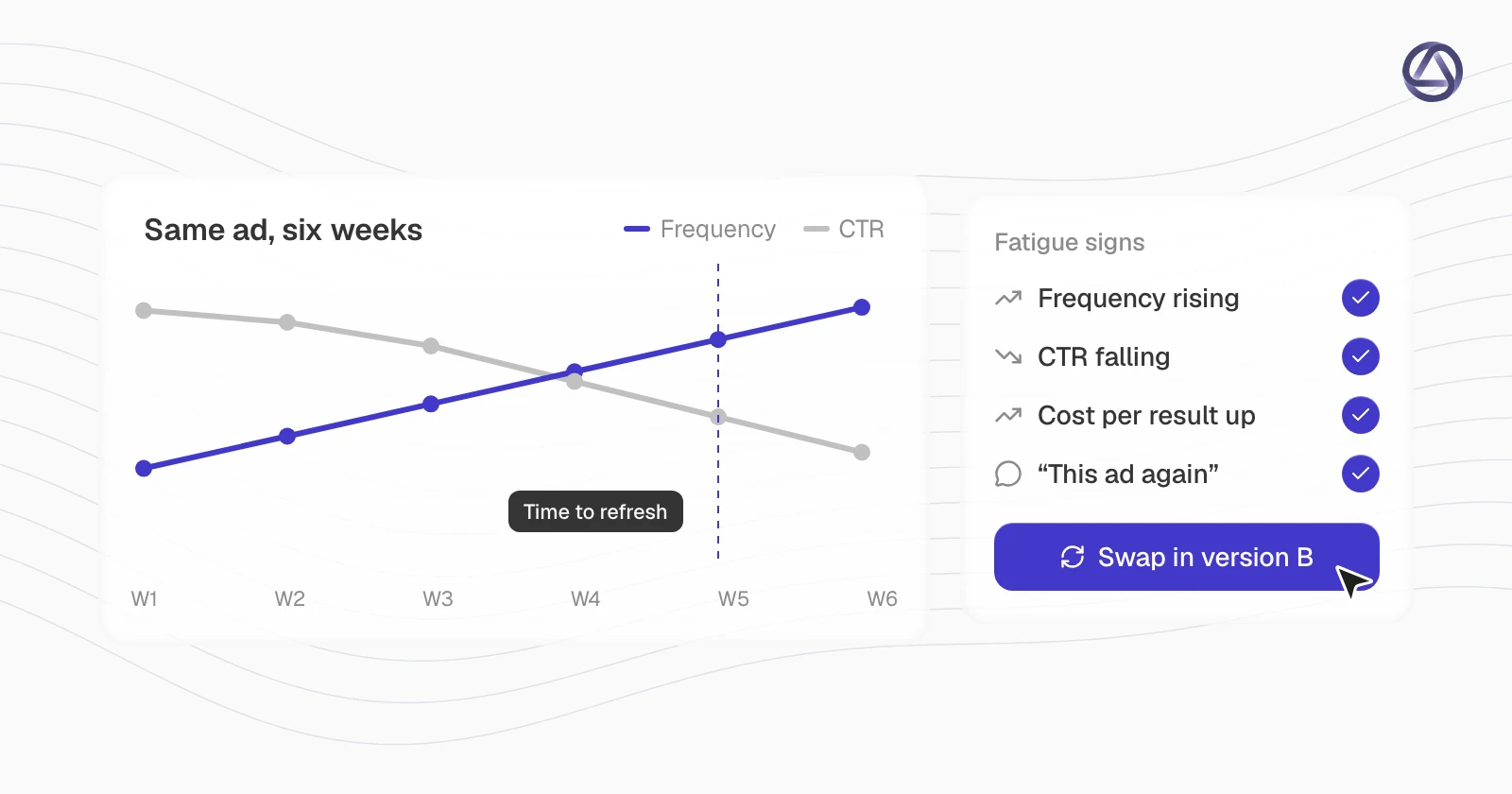
- Frequency keeps rising. Frequency is the average number of times one person has seen your ad. When it climbs week after week, the same people are getting the same message again and again.
- CTR falls. Click-through rate is the share of people who saw the ad and clicked. A steady slide with no change in targeting is a classic warning.
- Cost per result rises. Cost per result is what you pay for each enquiry, order or booking. If it creeps up while your budget and offer stay the same, check the ad itself before you blame the market.
- The same comments again. If the comment section fills with the same two or three questions, or the same tagged friend, the ad has stopped reaching fresh eyes.
- People say they have seen it. Comments like "this ad again" or a customer saying "I keep seeing your post" are the clearest sign. Treat them as data.
Pick a day each week to check these together and write the figures down. Fatigue is a trend, and a single bad day tells you little.
Why a small or local audience tires out sooner
An ad needs fresh people to stay effective. A big national brand has a huge audience to spread its budget across, so any one person sees the ad rarely.
A small business has a much smaller pool. Say you run a cafe in Bangsar and you target people within a few kilometres of your door. There are only so many office workers and families in that circle. Even a modest budget can put the same ad in front of the same people many times over.
The same applies to a tuition centre in Shah Alam, a dental clinic in Dubai Marina or a gym in Cheras. A narrow audience is a good thing, because it keeps your spend relevant. It also means you run out of new viewers faster, so your creative has to change more often.
Refresh the creative, keep the concept
When an ad tires, the temptation is to throw everything out and start again. Usually that wastes what you learned. If the idea behind the ad worked, keep it and change how it looks and sounds.
Think of the concept as the reason someone should care. For a cafe it might be "a calm place for a proper breakfast before work". For a skincare brand it might be "a simple routine for sensitive skin". That reason stays. You change one of these:
- The visual. A different photo, a new crop, another colour treatment, or a close-up instead of a wide shot.
- The hook. The first line or the first second. A question, a surprise, a customer detail, a price.
- The format. A single image becomes a carousel, a carousel becomes a short vertical video, a 1:1 post becomes 4:5 or 9:16.
- The angle. The same product shown through a different reason to buy: speed, comfort, value, a story, a season.
Change one thing at a time where you can. If you change everything and results improve, you won't know why.
Two examples
Example one: a neighbourhood cafe
Say you run a cafe in Bangsar. Your ad is a photo of your flat white with the line "Breakfast, sorted." It worked well for a few weeks. Now the same neighbours are seeing it daily and a regular tells you, "I see your coffee everywhere."
The concept stays: a calm, good breakfast near home. You make three versions. The first swaps the coffee photo for a shot of the window seat in morning light. The second keeps the photo but opens with "Your Monday needs a better start." The third turns your five best breakfast photos into a carousel with the opening hours on the last slide. Same cafe, same promise, three fresh looks.
Example two: an online skincare brand
Say you run a small skincare brand selling a gentle moisturiser online, with ads to a wider Malaysian audience in English and Malay. Your hook has been the ingredient list. Comments are repeating the same question about whether it suits oily skin.
You keep the concept of a simple routine for sensitive skin. One version answers the oily skin question directly. One shows a before and after routine in a short vertical video. One switches the caption to Malay for the audience that reads it more naturally. The angle moves from ingredients to everyday routine and the product stays the same.
Build a small bank of variations ahead of time
The worst time to make new creative is the day your results drop, because you rush.
Build a small bank in advance instead. Whenever you create an ad, make two or three alternates at the same time and keep them in a folder, unused. Name each one with what it changes, such as "window seat photo" or "Monday hook". When a live ad shows signs of fatigue, you pick the next version and swap it in.
A bank also keeps your approach consistent. Each version should still look like your brand, with the same logo, colours and tone, even when the photo and hook change.
A simple refresh rhythm
You need a rhythm so you aren't reacting to every dip. Here is one starting point, not a rule.
| When | What to do |
|---|---|
| Weekly | Check frequency, CTR, cost per result and comments. Note each direction. |
| Every two to three weeks | For a small local audience, swap in a new version even if numbers look fine. |
| Sooner | If two or more signs worsen together, swap right away. |
| Monthly | Retire the oldest version, then add two or three new ones to the bank. |
Your own numbers should overrule this. A cafe with a tiny radius may need to move faster. A brand reaching a wide audience can usually wait longer. Watch your own account for a few cycles and adjust the timing to match.
Festive seasons such as Hari Raya, Ramadan or Deepavali also give you a new hook for the same concept.
Where Marvis fits
If making several versions is the bottleneck, Marvis can help. You describe the product in a chat ("Craft your winning ads with just a chat") and ask for several versions of the same ad, each with a different hook or copy formula such as AIDA or PAS, in any language. The photo editor lets you adjust an image, and you can turn a set of photos into a carousel. The content calendar lets you plan posts and see what is scheduled for the month, so your bank of variations has dates attached.
Marvis drafts the ads. You decide which to run and how much to spend, and the platform's own reporting is still where you check frequency and cost per result. Marvis analytics show likes, comments and shares on your posts, which helps with the "same comments again" sign.
Your next step
Open your live ad today and check the frequency, the CTR trend and the last ten comments. Then draft two alternate versions of it, each changing only the visual or the hook, and save them in your bank. You can do this in a plain folder on your phone, or with Marvis after you sign up.