OmniNexus Team
Test Four Ad Versions Before You Boost a Listing
Draft four versions of one listing ad, change one thing at a time, post them organically, then boost only the winner. A practical test for working agents.
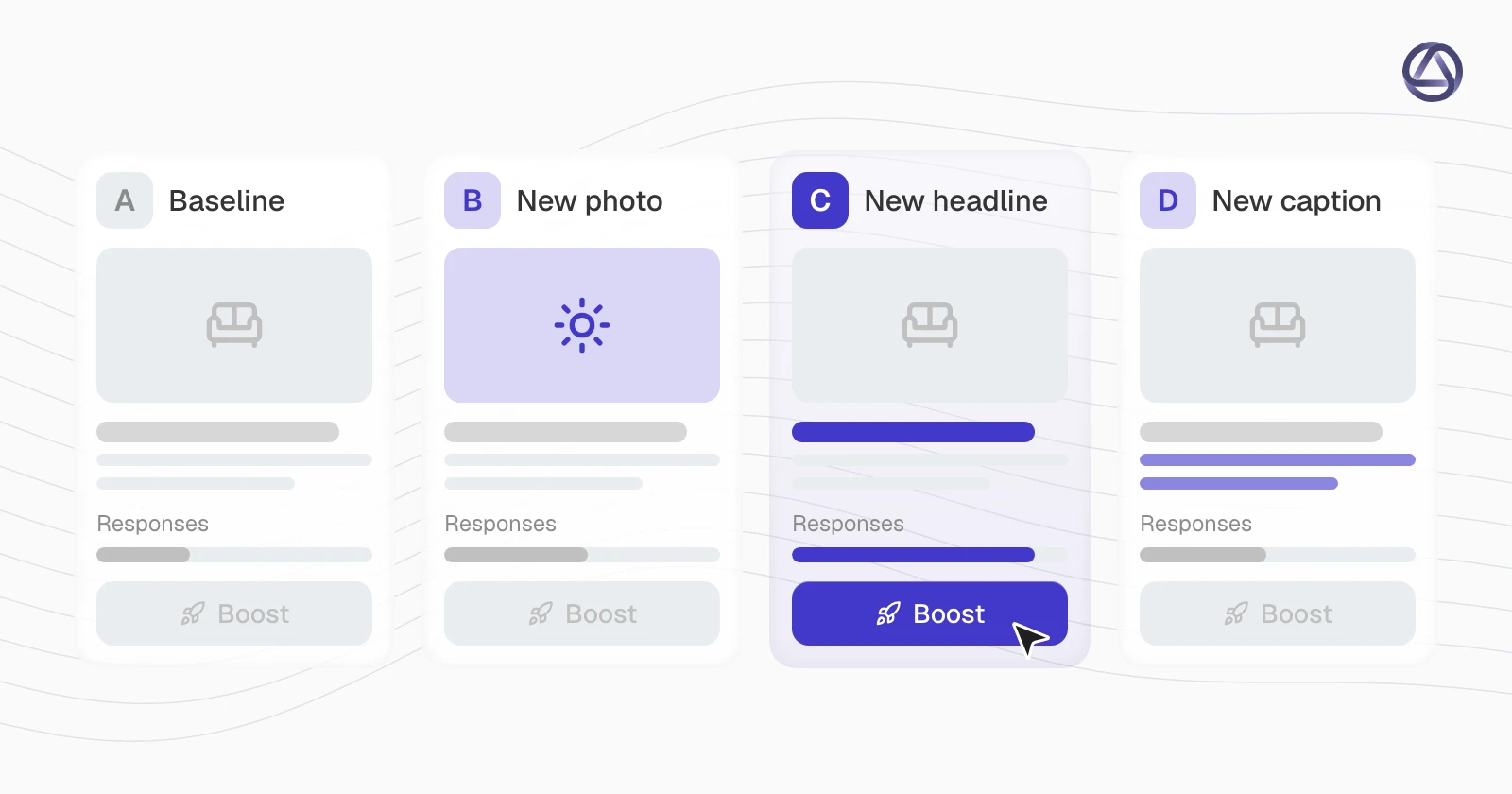
You have a subsale listing that needs more eyes. You pick the best photo, write a caption, press boost and wait. Three days later the numbers are poor, and you have no idea why. Was it the photo, the price in the headline, the caption, the area you targeted? You only made one ad, so you cannot tell.
The fix is cheap. Before you spend anything, make three or four versions of the ad and compare them. You will learn something even if every version does badly, because you will know which change moved the result.
The one rule: change one thing at a time
If version B has a new photo, a new headline and a new caption, and it beats version A, you still do not know which change did the work. So each version differs from the baseline in exactly one way.
Things worth testing, roughly in order of how much they tend to matter:
- The lead photo. This is what stops the scroll. Living room, balcony view, kitchen or the building exterior.
- The headline. The first line a buyer reads. Price up front, or the area, or a benefit.
- The caption formula. AIDA (attention, interest, desire, action) or PAS (problem, agitation, solution), or a plain facts-first version.
Things to keep fixed while you test: the unit details, the price, the call to action, the posting time and the audience. If you change those too, the comparison is muddied.
A worked example
Here is a made-up listing: a 3-bedroom subsale condo in Petaling Jaya, 1,100 square feet, asking RM780,000, near an LRT station, with a family buyer in mind. You write one baseline and three variations.
| Version | Lead photo | Headline | Caption |
|---|---|---|---|
| A (baseline) | Living room | "3 bedrooms in PJ, RM780,000" | Plain facts-first |
| B | Balcony view at dusk | As in A | As in A |
| C | As in A | "Walk to the LRT from your 3-bedroom home" | As in A |
| D | As in A | As in A | PAS: long commute, daily stress, a home five minutes from the station |
Notice that B, C and D are each compared with A, not with each other. If you want to combine the best photo with the best headline later, that is a second round, and it is a fine second round.
A short sample of the two caption styles for the same unit.
Facts-first (A):
3-bedroom condo in Petaling Jaya, 1,100 sq ft, RM780,000. Two parking bays. Viewing by appointment.
PAS (D):
Two hours a day in traffic adds up. This 3-bedroom condo in Petaling Jaya sits a short walk from the LRT, so the commute gets shorter and the evenings get longer. RM780,000. Message me to arrange a viewing.
Both are honest, and both say the same facts. They just open differently.
The same test works in Dubai. For a one-bedroom in Business Bay, version A could lead with the living room and version B with the Downtown Dubai skyline from the balcony. Everything else stays the same.
Run it organic first, then boost the winner
You do not need to pay to run the test. Post the versions as ordinary posts and see which one gets a response. Then put money behind only the one that earned it.
- Post version A on Monday evening, B on Tuesday evening, C on Wednesday, D on Thursday. Same time of day each time, so timing is not a variable.
- Read each one after the same number of days since it went up, such as three days, so the older posts do not get an unfair head start.
- Avoid posting all four at once to the same followers. They will see the same listing four times and it looks like spam. Spread them out, or use different channels for different versions if your audience differs by channel.
- Once all four have had their days, compare the results using the signals below.
- Boost the winner. Or, if nothing clearly won, do not boost yet. Change one more thing and try again.
Organic reach is small, and that is fine. What you want is a difference between versions, and small numbers can still show one.
What counts as a signal
Likes are the easiest thing to collect and the least useful. A friend taps a heart on the way past. It tells you almost nothing about whether a buyer cares.
Look for signals that cost the reader some effort:
- Comments asking about the unit. "Is the unit still available?", "What is the maintenance fee?", "Can I see it Saturday?" A question is a buyer thinking about it.
- Saves. Someone wants to come back to this listing. That is real interest.
- Shares. Someone thought a friend or family member should see it.
- Direct messages and enquiries. The clearest signal of all. Count them per version.
- Profile visits and link taps, if the platform shows them.
Give these more weight than likes. If version C has fewer likes than version A but two people asked about viewing, C won.
Keep a simple note for each version: its name, what changed, and the count of questions, saves, shares and enquiries. Four rows in a notebook is enough.
How to read the result
Be modest about what a small test can tell you. A handful of posts to your own audience is a hint, not proof.
- One version clearly ahead. Boost it. Note what changed in it, because that tells you something about your buyers for the next listing too.
- Two versions close. Pick the one with more enquiries, or run a second round between the two.
- Nothing stood out. That is information as well. The listing itself may be the issue: the price, the photos you have, the unit condition. No caption fixes a price that is out of line with the area.
- A version did worse than baseline. Good. You just avoided paying to promote it.
If a post was quiet because of the day, such as a public holiday or a Friday evening, say so in your notes and consider reposting it at a better time before you rule it out.
Spend small, then decide
A test is about learning cheaply, so keep the budget mindset the same. Decide your ceiling before you begin, a figure you would not mind losing. Do not raise it because one boost looked promising for a day.
Put money behind one winning version at a modest level and watch the same signals: questions, saves, shares and enquiries. If they come, you can raise the spend in steps. If they do not, stop and learn from it. You decide what to boost and how much. No tool should make that call for you.
Also decide what a good result looks like before you start. "Three serious enquiries for this unit" is a goal. "More engagement" is not.
Where Marvis fits
Writing four versions by hand takes a while, and it is the step many agents skip. Marvis, the tool we build at OmniNexus, is designed to help with that part: describe the listing in a chat and it drafts several ad versions for Instagram, Facebook, TikTok and LinkedIn, with your choice of tone and a formula such as AIDA or PAS. That is the idea behind "Craft your winning ads with just a chat".
If a draft comes with a score, do not read it as a forecast. A score does not tell you which version will bring enquiries. Your audience will tell you that. Marvis drafts the ads. You decide which versions to post, what to boost and how much to spend.
You can try Marvis, or run the whole test with a notebook and your phone. The method works either way.
Your next step
Pick your slowest-moving listing this week. Write a baseline ad, then three versions that each change one thing: the photo, the headline and the caption formula. Post them on four evenings, note the questions and saves, and boost only the one that earned it.